

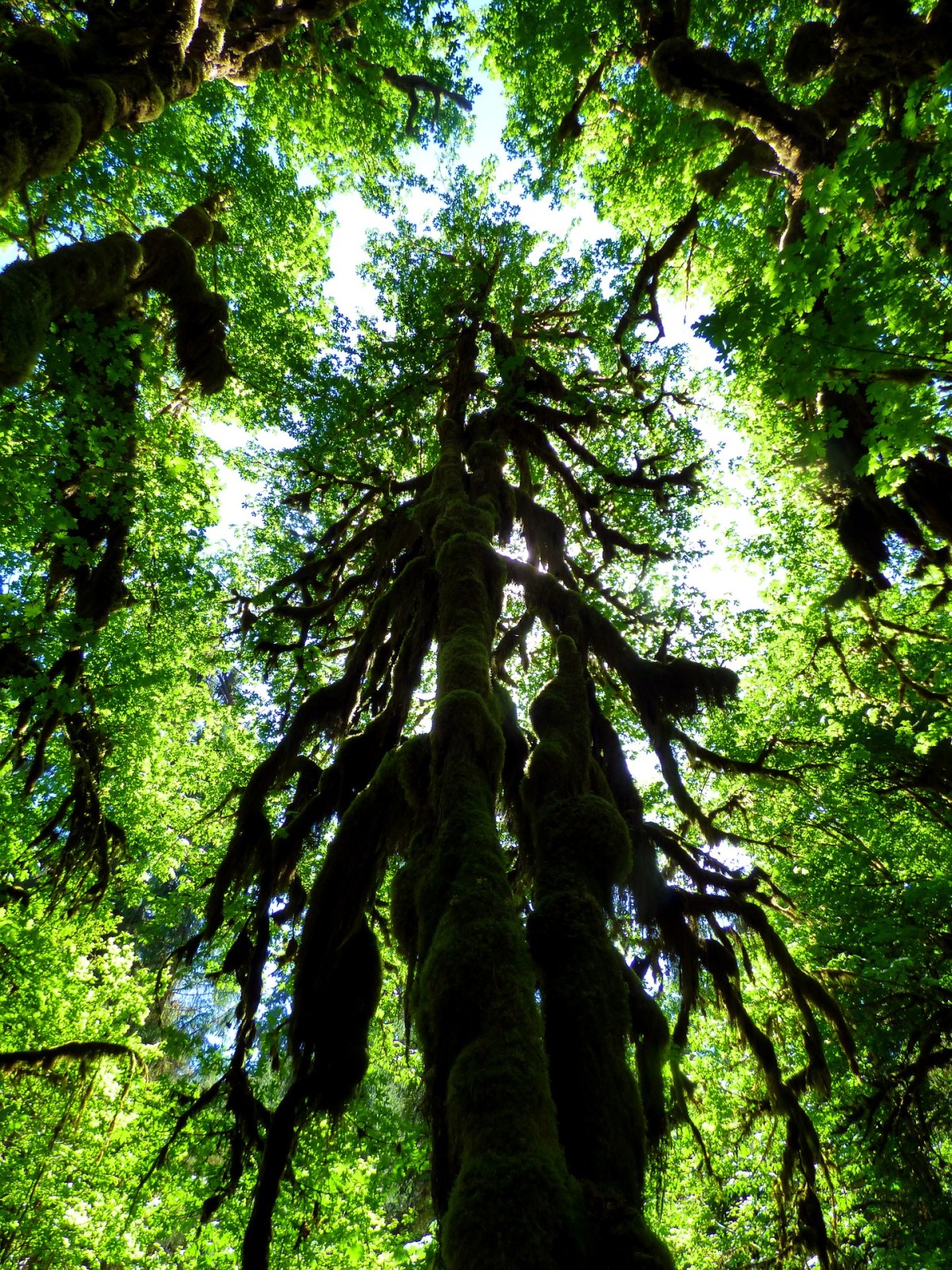
The angular face of a crone, sharp and aquiline, with a white and gray nimbus of wild hair, and a pair black and golden eyes peered down into the bower where the young man was held, wrapped in vines. A young woman with piercing emerald eyes, pawed at the young man, stroking his face and brow, arms and chest, whispering to him words that could not be overheard, but seemed to have an effect on him so that he blushed, and his eyes widened at what she was saying. A net of woven branches and vines formed a mesh beneath them, yet the leafy canopy from the top was partially open to the treetops and the sky beyond.
“What you got in there, twigsy?!”
The voice was harsh and raspy as if spoken by someone who had spent their whole life filling their mouth and lungs with smoke, desiccating their vocal cords. The young woman started and turned her head upward, searching for the source of the raspy voice.
The crone cackled, her angular and aged face disappearing from one vantage point and then reappearing from another, outside of the girl’s field of search.
A patina of leafy green passed over the girl’s face as she searched the leafy canopy encircled about her and the young man.
“He’s mine!” she spat and hissed at the seemingly disembodied voice, “I found him!”
The branches above shook rustling the thick mats of leaves covering the high bower, as whatever it was seemed to bound over the top of the canopy, shrieking and laughing harshly.
The young man looked up beyond the girl, his face previously enraptured and enchanted by the attentions of the beautiful girl, now seemed to shake the influence and glare angrily.
“Leave us alone!” he yelled, “Go away!”
He made an effort to strike out at the being but felt hindered, only now seeming to realize, with puzzlement, that his arms and legs were entangled in the vines holding him to the woven walls.
From behind him, the old crone’s face appeared through the dense leaves, “He doesn’t know what you are!” she cackled, shrieking with derisive laughter.
“Tell him what you are, woody dear!” and her head ducked away, as the nymph girl turned suddenly, seeing only the rustle of leaves as they enfolded over the retracted darting face of the ugly crone.
A raw, throaty whisper, rasped, “Tell him what you are!”
The girl lunged at the dense leaves, vines sprouting angrily from her fingertips, “Harpy! Child-killing harpy!”
A sheath of vines and foliage shrouded the woman’s once smooth, cream-colored complexion, as her anger flared, forgetting to maintain the illusion for the young man she had beckoned and wooed, awaiting her in the cocoon bower below. Her body rustled with unfolding leaves, and an intricate network of veins that wrapped her body like swirling, grids of tattoo work, rapidly inking her smooth luxuriant skin before his very eyes as she crawled up the sides and along the ceiling of the vine-woven cage she had brought him to for more private intimate attention.
The young man’s eyes went wide in terror, realizing what he’d thought was a sensuous young woman was actually something else entirely. He struggled violently against the vines that held him, his heart racing his breathing becoming labored and panicked, expelling some of the pheromonal dust he’d breathed in.
“What ARE you?”
The dryad woman cursed and hissed in frustration at the old crone somewhere on the outside of the bower cocoon.
“Mood-killer! Meddling bat-faced hag!”
Then remembering her captive, she gasped and turned to look downward at him, her skin suddenly smoothing out, the varicose vascular lines fading and descending back below her epidermal layer, the sprouted leaves covering her slender feminine figure shrinking and withering down to disappear within her dilated pores. A patina of green flashed over her complexion as she fought to regain her blushing composure for the young man’s benefit.
She coughed at him, expelling a puff of yellow smoke from her pouted lips that rained down a cloud of fine dust upon the bound young man. “Tell me your name again, sweet, beautiful man,” she said seductively, as she slid sinuously down from a vine in the ceiling.
A euphoric glaze seemed to pass over the young man as he again breathed in the dust, forgetting his panic, surrendering once more to the desire that had beckoned him to follow the young woman when she’d invited him to play.
“My name is Will,” he said, his mind surrendering the memory of what he’d just witnessed, to the possibility that whatever this yellow dust was that covered his face and body must be some hallucinogen and that the scare he’d just had was only a temporary drug-induced nightmare attempting to replace the pleasure of the dream he wanted to come true with this exotic and fascinating girl.
The girl responded, her voice soothing and soft as warm butter, “And my name is Syloam. You are a very beautiful man, Will and I want you. I am going to have you…WITHOUT INTERRUPTIONS!” she added the last loudly directed to the cone-faced creature that had harassed her and distracted her from without.
She moved down to his level, knelt and placed her hands upon his shoulders, then ran them smoothly up the sides of his neck, kneading his tense muscles as she did so, and then proceeded to cup the sides of his face, move forward and kissing his face gently with soft feather touches of her lips.
Her eyes were so beautiful, and Will could not turn away from her as she gazed directly into his own with desire he reciprocated. Never had he felt such wanting. She then moved in to kiss him fiercely and hungrily on the mouth, and he struggled forward to meet her but the restraints prevented him from embracing her and holding her.
When she finally withdrew from the kiss, she pulled back, patting his head and tousling his hair like she might a small boy.
“Stay put, Will. Your Syloam will be right back, shortly. I just need to ensure we are not interrupted again.”
***
Dellitch the crone-faced Harpy, smiled as she hopped out of the canopy upon a high limb that stood like a crooked talon above the tops of the other trees and was mostly barren of leaves. The sun’s rays bathed her bizarre body in a golden light revealing her strange features to the witness of the sky. She made a chirrup-chirrup noise in the back of her throat, a very bird-like sound, as she shuffled and extended her large black feathered wings, and placed her large grey talons with black hooked claws upon the branch adjusting her balance in the breeze that wafted over the forest treetops, rustling and sighing through the leaves making visible its transit along the foliage sea of green. She bore a feathered ruffle below her jowly neck, like a bola wrap, under which jutted the curved tops of two prodigious grey-skinned bosoms. Frothy, milky wetness glistened the chest-feather plumage and clabbered in the ruffles below it, giving off the distinctive sour odor of curdled milk. Her body stood about four feet tall from the crown of her wildly flowing grey hair to the bottoms of her fat clawed feet. She had no arms to speak of, only large black wings that stretched from twelve to fifteen feet across from tip to tip, with a hooked barb jutting out from the wrist joint at the end of the patagium of each wing.
Harpies were hated by the dryads for many reasons, but certain reasons stood out among the others. The dryad females found that they were unable to breastfeed their infant children with their mother’s milk. Tree sap was all their hybrid bodies could produce but it offered no sustenance to the infants. Cattle had not been domesticated to the point that they might offer their children milk that might nourish their half-human bodies, and the only creatures among them that seemed capable of offering a milk-like drink were the harpies. The harpies were then not as ancient and old in visage as they were now, and the harpies agreed to share their milk with the dryad nursery on the condition of being given a portion of the forest in which the dryads occupied. Only the milk was later found to be poisonous to the infant dryads, causing blight to wither and kill their plant nature and spread disease to the trees around them. The effect of the poison was slow working, but irreversible, and no antidote could be found that would save the lives of the infant dryads. Further, the disease once spread to the trees and then dispersed in the pollination, worked as a unique genetic pathogen that suppressed the production of Y chromosomes making the dryad females only capable of producing female children, and no males. The milk of the harpies had served as a death sentence to the race of dryads, and they were forced to flee their home forests and seek virgin forests that were unspoiled by the contagion spread by the Harpies.
Dryads were not vulnerable to the Harpies unless their blood or an open wound was mixed with the lactate of the latter. For this reason, most dryads were easily cowed by the Harpies, and avoided direct combat with them, lest they be raked with a claw and pressed into their lactating breast ruffle.
Harpies had no offspring. They were incapable of breeding and resentful of the dryads’ propensity to remain youthful in appearance and evergreen, while they aged and became more and more embittered and ostracized by the other races of Half-men. They were only too happy to clear out an area of forest from dryads, whenever The Pan requested it, merely by showing up. They too reciprocally hated the dryads, but it was a matter of deep envy, and a frustrating drive to covet their libertine lifestyle. They happily occupied the blighted forest that the dryads had vacated. Since there would never be more of their kind, they felt entitled to it since they had been dealt such a harsh sentence of prolonged misery by the One who had forbidden them to worship any other god or aspect of creation but Him alone. They too could be killed, and some dryads had been instrumental in bringing that about, but the Harpies felt the loss greater because they could never have more of their kind. The resentment between the two groups had been growing but held in a delicate balance by The Pan who manipulated both to serve his purposes.
The dryads could be driven to such rages, that they turned on the Harpies and fought them, without thought to the potential consequences, and the Harpies were skilled provocateurs. The Harpies worked up their vile milk froth, a few days before a conflict, allowing the substance to spill down their front, so that the dryads, who saw and smelled its days-old rancid smell would fear them enough to flee while self-preservation was still at the forefront of their minds. Being a part bird, they had the advantage of swift flight and could evade the dryads who could only climb after them from the tops of the trees or hope to ensnare them in a woven net and then beat them to death with rocks. Only the dryads had figured out one other indignity that enraged the Harpies even further. If they ever could catch one, without the risk of being cut or clawed, they would instead maim the creature by cutting off its feet. Among the dryads, the severed claw-foot of a Harpy was a sign of warning and they bore it as a crest.
So Dellitch and her harpy sisters had been fitted and prepped with something that only the humans could forge for them, and the trolls in their dealings with The Pan delivered these to them for his distribution to the Harpies, for a commitment that he would employ their threatening services to keep the dryads in line from taking Xarmnian men and boys and give them consequence if they failed to comply.
Dellitch wore these armored fittings proudly on the shanks of her legs down to the knuckles of her clawed feet. Iron bands that would make the severing of a claw by a dryad from a distance or even up close impossible. Now Dellitch only had to wait for the angry little dryad to come to her. Where she would be dealt with swiftly and severely.
***
Beneath the city of Azragoth, deep within the underground network of tunnels, a silent army of hundreds was being slowly awakened. A twisting, curling breeze of powdered dust-billows sifted through an outside grating, swirled through a pipe chute of silt strained from the dry water run of a splinter-stream and navigated smoky corridors to the darkened parade cavern where the Dust Dragon had established its lair and began reproducing its golem totems from the clay and dust of the hidden city above. The moldings had begun to cure as their hollow eyes received the powdered stirring, from the strange breeze, that channeled its dusty tendrils into the statuary poised to receive the mysterious breaths of the bizarre streams of curling smoke.
Line after line of clay-figured heads broke their crusted molding as their necks bend back, thrusting the statute figure’s chin upward, their terracotta lips gaping to receive more of the swirling powder. An eerie sort of respiration noise began deep within the hollow cavity of each golem attended by the tendrils of swirling dust. Fine powder sloughed off these figures as their fingers curled, and their arms slowly moved with a grating noise as if kiln-fired bricks had been dragged across a slate stone floor. The eyes of each closed and then blinked open with a white sclera and a jeweled iris dilated almost to blackness. The first lines of the awakening army had already moved out from the cavern and proceeded down through the darkened tunnels making their way to the hoist chute and winding stair beneath the city leading up to The Keep towers above. Eight of the previously cured and awakened golems had ascended the winding stair. Eight who bore the uncanny resemblance to the reluctant leader of the party of Surface Worlders who had left the city, prior to its attack. Each of these eight carried sharp jagged stones intent on forcing their way into the hidden city above.
***
Captain Thrax had heard of the assault upon General Mattox, and he had heard that while the General was in bad shape, he had barely avoided being mortally wounded by imposters that had somehow infiltrated the city. A detachment of soldiers, led by Lieutenant Morgrath had been withdrawn from the central bastille and dispatched to The Keep pavilion to investigate a possible breach point through the underground tunnels. Three of the retinue soldiers of General Mattox had been slain by the traitorous archers before they had been captured and interrogated. The General had dispatched two riders to seek out Captain Lorgray from the backwoods and call his company in to rally to the city, for all their defenses would be necessary to guard what was soon to come.
The man who had delivered these messages to the Captain had looked vaguely familiar to him, though he was unable to place the name with the face of the messenger. The thought bothered him, but he did not know why it did.
***
Morgrath moved carefully up the winding stairwell, leaning closely against the inner stone balustrade. Being left-handed gave him an advantage in the ascent that many of his troops did not have. With the curve of the interior stair moving in a clockwise rotation upward, the arc of the interior wall gave very little room for one who fought right-handed to draw of swing their sword arm. Any strike they made towards an attacker above them would be impeded by the need to cross their body to parry the blow of an attacker descending. Being a left-hander, gave Morgrath the advantage of blocking and hacking the defenses of the opponent, with a reciprocal blow that the offender would have to brush away moving his arm from center to right, against the natural bend of the wrist and elbow.
Morgrath also had both ascended and descended the stairs of The Keep many times and well-knew the cadence of varying lengths and height of the steps so that he could carry feed bags up and down the stairwells without missing a step or faltering upon the uneven parts. With the ascending towers on either side of the tall Keep, he had hand-picked his men, to include a fair number of left-handers among them, so that interior defense could be affected from the ground up to the top descending stair. The General had given him an order, that he would normally have been loathed to follow, but he trusted the commander’s instincts and knew, that he would carry it out. When he and his men had found the dead guard in the turret tower, he knew something was wrong and though his orders seemed extreme, he was worried that perhaps the General was right in the order he had given.
Having had no real way to tell, what was below the city, Morgrath knew that the threat posed by the Dust Dragon they’d found slain by the Surface Worlder called Mr. O’Brian, had shaken several to the vulnerability that the caves and tunnel systems posed if they were discovered by the wrong people. The chain locked winches would be hard to move, even on the drum spindle, for the silos had been sealed for many, many, years. Unlocking the traps would be difficult. The counterweights designed by Nem would, in theory, cause the bulwarks to tilt and buckle, and the weight of the stored grain, would burst the floor and bury the central stair, collapsing its superstructure under tons of flowing grain. Whatever was down there, would have to find another way, besides The Keep, to gain entrance into the city of Azragoth.
***
Mattox coughed a pinkish froth, as he drew in a shortened ragged breath. Ezra stood at his side, supporting him with his shoulder, and Mattox’s arm draped around him.
“We need to get you to the surgeon, General,” he spoke quietly but firmly.
Mattox winced as any small movement caused the arrow point to auger in the wound.
He whispered under his breath so that the bound imposters would not hear his response.
“They thrive on weakness,” he muttered, “Mustn’t show…[cough]…”
“The One is strong in our weakness,” Ezra advised, nodding to the other bodyguard to help him withdraw Mattox further from the garrison, toward the apothecary shops and surgeon’s quarters up at the end of the street.
“We will attend to these three,” he said. The other figure, who had posed as an archer and had shot Mattox, had been felled, by a slinger, and his body had toppled over the wall, falling into the flaming oil trough, and dissolved into the flames. The fire seemed to flare as the Banshee quitted the golem body-double of O’Brian, and fiery sparks wafted into the air, turning end over end, swirling and then moving outward toward the forest fires ahead.
A breathy sigh, almost a hiss, had attended the expulsion of the Banshee, but it was not clear if any actual harm had been done to it.
As long as these remaining three were contained within these fashioned bodies, they could get into no further mischief. The problem was, where to keep them in the meantime.
Nem joined Ezra as he surrendered the charge of the care of General Mattox into the capable hands of his trusted bodyguards, Jesh and Kadmi.
“What shall we do with these three?” Ezra asked as the two of them looked away from the General back to the three prisoners tied up.
“These three are why Azragoth has the oubliettes,” Nem said simply.
***
Mattox had been lain upon a thatch-woven frame and was carried by both of his personal guards, Jesh, a tall angular framed warrior whose stature was slightly taller than that of General Mattox, such that, in battle assassins often confused him with the General because they share the same built, but opponents often assumed height signified prominence. Among the proud Xarmnians, one was never allowed to outshine or stand taller on a battlefield that their commanders and they mistakenly applied their own assumptions on that of their enemies. Knowing this, the brave man had volunteered for the position and had earned it many times over. Kadmin was by contrast, fairly short and thick-shouldered. Between the two of them they covered Mattox from both low and high assaults and Mattox had come to trust and rely on these two men, offering both a command of their own but they had refused and would not leave their General’s side. Theirs was a duty of honor, and they counted it a privilege.
Mattox tried to rise as he was lifted and carried but they had admonished him to lay still and not let the arrow work any further into the wound. Mattox sighed and lay back, but spoke urgently, though quietly.
“What is happening with The Keep?” he took in a ragged breath.
“Morgrath is carrying out your orders, sir. General, I must insist that you…”
Mattox raised a gloved hand, a signal that there was no need.
“Call Lorgray to me as soon as he gets in. Tell him it is time to seek out and find Jeremiah. Now that we’ve found the location of the second Honor Sword, it is time that he came back to Azragoth to reclaim the Cordis stone.”
***
The wooden door at the top of the stairway of the Keep had been struck from behind, splintered, cracked, and wrenched off its hinges. The darkness beyond the broken door frame gaped like an open throat—ominous and sinister—and insatiably hungry. Morgrath approached it with caution, defensive and ready should something evil emerge from the pregnant darkness below. His sword was drawn and raised for a quick diagonal slash. Eleven other men had followed him up the stairwell, ready to rally to his side at his signal.
The stone stairwell leading down into the tunnels below the city was built into the central tower of the Keep, mounted upon jutting corbel blocks and buttressed by crossing interior beams that formed the infrastructure of the central shaft. A series of small platforms and stone landings descended and twisted into the darkness like a curved gray tongue. At each landing, there was had been a lighted sconce, but these had been snuffed out so that the interior was cast into pitch blackness.
The small eyelet windows set high in the stone walls above the top of the landing only allowed a certain half-light into the top room but did not penetrate deep enough to light this recessed central doorway. These light beams which squeezed through the narrow windows swam with shadowy dust motes, swirling like a superimposed microbial universe projected into the air and smelled of a sickly-sweet malt odor. Morgrath recognized the smell. Grain dust and ground corn pulverized into cornmeal. The Keep’s silo doors had been opened as well. The formerly lighted sconces that once illumined the branching barrel vault hallways on either side had been snuffed and the top guards who regularly stood post at the top of the descending room were nowhere to be found.
The ascent stair tower they had emerged from had external arrow loop windows set within the exterior wall so that the stairs were bathed a certain half-light and did not require lighted braziers or torch sconces during the day, though they were fitted with torch brackets for nighttime ascents. When they found the top of the stair room darkened, they had struck flint and re-lit a few torches so as not to be taken unaware by whomever or whatever lurked ahead.
Morgrath reached back and took a torch from one of his men. He lifted the flickering torch and moved closer, seeing only bouncing shadows cast from the twisting firelight within the central doorway. He lifted it higher as he approached and briefly illumined a portion of the first landing no more than twelve feet below. He could not be sure but he believed he heard sudden movements from within as if many feet pulled back into the deeper darkness evading the dancing light descending the stairwell.
Two large half-turret rooms flanked the central doorway. Each featured a large capstan spindle within, bristling with hand-smoothed crossbeams running through the metal-bound drums. Each capstan was set directly in the center of the circular stone chambers that worked a large wooden column extending from the top of the capstan to a greased borehole in the top of the arched ceiling and then down through the stone floor to some buried mechanical cog and gears deep within the wells of the Keep below. These vertical shafts were the size of a large ship’s masts and every bit as thick. Whatever power could be generated to turn these capstan spindles would require more than one man’s strength to move it, however, the large beams crossing the spindle made such a task entirely possible with the effort of at least two men working to push the beams. This mechanism served a two-fold purpose. It opened and closed the grain floor sluice troughs below each of the stone silos. The sheer volume and weight of the grain in the silos did the rest. Pouring down into the catcher chutes that ran on either side of the wooden stairway that descended to the floor of the caverns below. The capstans were never turned more than a few feet within the turrets above, for the flow of kernels and grain would become too great and overwhelm the grain chutes and spill out onto the central stair. Turn these capstans any further and the sluice gates could not be closed by any man or beast for the tonnage of falling grain would overwhelm the stair, slamming into the wooden stairwell and flood the corridors below, until the massive silos were emptied. To prevent such from happening, metal bar staves were fitted into the floor of the circular room stopping the turn of the capstan spindle. Each of the staves had a curved eyering at the top, in case they had to be removed and repositioned in the floor as the measured grain levels in each silo required the sluice gate to open wider.
Morgrath ordered four of his men into the circular rooms to pull up the staves. They quickly did so using a metal bar, hung from a peg within the chamber, running it through the eyering and pulling them up from the stone bored holes in the floor. Other men fanned into the room bearing spears which they aimed threateningly over small half-shields down the corridor of each barrel vault tunnel leading to the storage silos at either end.
The freight shaft rooms were deep below and the base of The Keep. Wagons could be drawn into them with a small team of horses to be let into the city, from below, but the gantry and counterweight systems were operated from the top rooms of the Keep towers next to the silos. If the enemies below knew anything about the working of these freight shaft systems, they would realize that if they were to mobilize an army to rise up from below, they must bring larger numbers of fighters and weapons up through the freight elevators below. For this knowledge, they would need to keep the gate sentries alive to operate the elevating levers and counter-balancing weights until they were satisfied that they could operate the lifts themselves. After that, these persons would be of no use and their lives forfeit. Somewhere within, a few might still be alive and held at knife or spear point.
Something tugged at Morgrath’s mind. Some further mystery that seemed relatively important about the empty upper room, given the gravity of the dead in the doorway below and the darkness and destructive forces evident in the central room at the top of the Keep. Some difference that nagged his subconsciousness, that he could not immediately identify at the moment because of the imminent danger posed by whatever waited in the silo rooms and down the descending steps in the tunnels below the city.
Another of his men turned to Morgrath and asked the question that brought back the missing detail in stark relief.
“Where have all the cats gone?”
***
Maeven knew there was no way she could reach Will once the dryad had pulled him up into the canopy. She might have been able to prevent it if she had her bow, but Mason carried it on the road ahead. There was no telling how long the dryad would let him live, but there was very little hope that it would be long enough to allow her to return with her bow. Much as she hated to abandon him to his terrible fate, she would have to return and catch up to the company. There was nothing more she could do but hope that Will’s death would come swiftly.
She ran as fast as she dared without creating too much noise, trying to make it back to the road and catch up with O’Brian and the others. There was no telling what the others may be walking into and with the satyrs in the forest and now the confirmation that the harpies and dryads were present as well, it made sense that the presence of The Pan would be the reason why these contentious groups were in the vicinity. Only the Pan unified them.
Their only hope was to reach the Faerie Fade.

 Excavatia