*Scene 01* 08:34 (Loose Ends)
Just below the stone wall, next to a now cold and dried firepit, Grum-Blud watched the guard standing post at the old shed, as he leaned against the cross-beamed corner of the structure, through a crenellated groove in the stone. He grinned as he watched the ‘guard’ turn his head this way and that, and then nod forward, jerking his head upright and blinking rapidly, realizing that the erstwhile sentry was growing weary in his present duty. If there was someone supposed to relieve the man, they were late in coming. This one would succumb soon, and Grum-Blud would be all too pleased to see that he never woke up again.
Finally, the man leaned forward on his bowstaff, and slunk down to a seated position against the interlocking saddle-notch corner, with the intention of being able to see along both walls of the structure, but his wearied body, feeling the ease of the new position, lured him into a comforting lull. In a few moments, the man was snoring, oblivious to the new and present danger posed by the squat, apish creature, that slunk over the stone wall, with a melon-sized rock in its knobby and callused hand, barely able to contain a fiendish chuckle from escaping its large, jaundiced teeth, and crooked smile.
A brutish thunk sound preceded the skulking figure’s waddling step-hop, as the creature made its way from one victim to its intended, with a snuffling hoggish grunt.
A makeshift patch of hewn wood and stone blocked and covered a torn and splintered opening in the planked wall of the holding shed, with staked branches. The shed was comprised of a combination of stone and cross-notched logs forming the walls on three sides, with the longer plankwall being the last installation. The patch was not designed to improve the aesthetic look of the shed, by any stretch, but served more as a functional impediment to forestall whatever might be contained within its shored-up wall from getting out. On closer inspection, the brutish intruder, realized that what was now serving as an enclosed shed, had once served as a small stable, with the plank wall covering the elongated opening were cows or horses might have come for milking or to feed at a manger trough along the back, log-and-stone wall. The side door was cut and installed in the structure’s short side, later for human-sized ingress and egress.
Grum-Blud chuffed a misty smoke from his rubbery lips into the cool morning air as, with his large muscular arms, elongated and corded, he tore away the braces, stones and planks, covering the erstwhile animals’ opening. He relished the anticipated look of surprise that might be on Corg’s face, when he saw whom it was that had come to ‘rescue’ him.
“Who’s there?!” a gruff voice of alarm came from within.
Grum-Blud hesitated, as he reached for the last board covering the splintered hole in the wall of the shed. The voice did not sound like it belonged to Corg. Growling low, with a snort, his callused paw ripped away the plank and cast it behind him. He mounted the fallen pile of stones that he had broken through holding the base of the braces and ‘patch’, his shadowy form silhoetted against the misty morning dawn.
A man’s form lay huddled in a corner, laying on a small mound of straw, arms bandaged, but not tied. Grum-Blud sniffed the musty air inside, as the figure tried to rise to a full seated position.
“Where is Corg?!” Grum-Blud growled, threatening.
“Corg?” the man in the corner blinked, rocking himself forward, attempting to rise. “Corg!” Grum-Blud moved into the shed, partially blocking the dim light filtering around his squat body, arms hanging to the floor, his knuckles pressing down hard on the floorboards.
“Y-your a troll,” the man’s voice croaked. “Another one.”
With a swift move forward, swinging its short thick legs, kicking over its fists, Grum-Blud landed in front of the rising man with a hard stomping thud, coughing his demanded interrogative. “Corg!”
“Dead. Burned.” the quavering man answered, cowering backward.
“How?!” Grum-Blud demanded, raising a fist at the shrinking man.
“Stabbed,” the man replied, adding a lie. “They did it.”
Grum-Blud grabbed the man’s arm and said, “Come with me!” Before the man knew it, he was jerked off his feet, dragged behind the troll, through the rough opening in the wall and out into the morning twilight, raked across the jumbled patchwork pile and flung into the dirt yard.
In the outer light, Grum-Blud’s eyes narrowed into a scowl as he sniffed and examined the man in the misty light.
“You are Xarmnian!” Grum-Blud stated, brooking no contradiction. “A scout, from the look of you.” He sniffed again, growling low and grunting pig-like.
“There is troll blood on you,” his thick brows furrowed. “Smells familiar, I think!” The man flinched guility, and Grum-Blud moved toward where the Xarmnian had fallen, suspicion darkening his countenance.
“Th-They stabbed him when they captured him. He and I were their prisoners. Both of us were held in that shed together. He bled all over me, before he succumbed to his injuries.”
Grum-Blud’s arms bulged and his knobby knuckles flexed and fisted, weighing the man’s words, measuring them against his own rising suspicions. A sneer dropped half of his lips into a crooked smile as he moved closer to the cowering man, a wicked gleam shining in his eyes. “If that is true, you will have no qualms with me looking into your dark, lying soul.”
The Xarmnian gasped, quickly averting his face, scrabbling to get away from the troll as fast as he could. Clawing to his feet, but wincing as he flexed his wounded arm.
Suddenly, he was slammed to the ground, the surprising weight of the troll pressed his face hard into the mud. The troll grabbed a fist full of the Xarmnian’s hard and yanked him up into a back arch, the feel of a cold steel blade pressed sharply under his exposed throat. The smell of dried blood, and the stench of cloying sweat, and foul breath caused the Xarmnian to gasp, as Grum-Blud growled into the man’s ear. “Lie to me…and you will bleed for it!” the troll huffed, “I need only release your hairy mop, and this blade at your scrawny neck will eternally stop your ability to answer. Understand?!”
The Xarmian mewled, pleading as he had never before. Finally comprehending how dangerous one of these trolls could be. Grum-Blud could feel the man’s surrender and despair, as the taut, fear-fed resistance slackened. Carefully, but deliberately, the blade’s iced razor kiss lowered, with only a lipstick blush, beaded along its edge. The man felt the troll’s weight shift off of his back, but his hair was still in the tight grasp of the creature, twisting him over to stare up into the glowering face. The last reflection the Xarmnian had in his cruel, miserable, but shortened life was of a set of piercing black troll’s eyes floating above him, pushing him back into a recent memory he desperately did not wish to reveal.
*Scene 02* 7:00 (Across The Inter-Land)
The Hill of Skulls stood ominously atop a winded slope, looming stoically against a grey morning sky. Hanokh, The Walker, stood before it, his head bowed, listening.
He appeared to be having a silent conversation with himself, only his focus was directly aimed at the mount itself. He was within the outer thorn hedge and stood before the large stone assemblage that encircled the mound with the footpath bordering it. He had seen evidence of wagon tracks, and the prints of many horses that had pocked and dug divots in the outer perimeter. Others had visited recently, but many of the tracks had been washed over or pitted with the evidence of recent rains.
Slowly, reverently, he moved along the footpath heading to the westward facing side of the mound, scanning its rising surface. As he circled had stopped up short when he saw it.
A gentle beam of blue light pierced the distant cloud cover and shone on a portion of the elevated surface, where dirt and stone had been sloughed away leaving an exposed pit that was widening. From the lower angle, it was difficult to see, but he could just make out that there was writing on the inner surface that appeared in an ancient script. Hieroglyphic in nature, with pictorial representations of phonetic sounds. A proto-script he immediately recognized as one he himself had devised long ago.
“Names,” he muttered to himself, as a knowing smile crept into his solemn countenance. He nodded appreciatively, and then with a turn towards the northwest, he vanished from sight, already certain of where he would need to go next…to be sure.
∞
Hanokh appeared in a grove that extended perpendicular to a rising rocky escarpment. The grove was a ranking assortment of various trees aligned along a flowing stream of clear water, which emerged out of the side of the rising escarpment, cascading down into a catcher pool and then flowing along a channeled gully into the stream.
Hanokh knew for certain that this very stream had once been a dried riverbed, full of fallen leaves. But now it ran cool and clear, feeding the roots of the trees that edged its riverbanks.
Then the angel showed me a river with the water of life, clear as crystal, flowing from the throne of God and of the Lamb. It flowed down the center of the main street. On each side of the river grew a tree of life, bearing twelve crops of fruit, with a fresh crop each month. The leaves were used for medicine to heal the nations. [Rev 22:1-2 NLT]
The Ancient Text verse sprang to his mind.
O LORD, the hope of Israel, all who turn away from you will be disgraced. They will be buried in the dust of the earth, for they have abandoned the LORD, the fountain of living water. [Jer 17:13 NLT]
Another more in-depth passage lingered from the account of the prophet Ezekiel.
1 Then he brought me back to the entrance of the temple and there was water flowing from under the threshold of the temple toward the east, for the temple faced east. The water was coming down from under the south side of the threshold of the temple, south of the altar. 2 Next he brought me out by way of the north gate and led me around the outside to the outer gate that faced east; there the water was trickling from the south side. 3 As the man went out east with a measuring line in his hand, he measured off a third of a mile and led me through the water. It came up to my ankles. 4 Then he measured off a third of a mile and led me through the water. It came up to my knees. He measured off another third of a mile and led me through the water. It came up to my waist. 5 Again he measured off a third of a mile, and it was a river that I could not cross on foot. For the water had risen; it was deep enough to swim in, a river that could not be crossed on foot. 6 He asked me, “Do you see this, son of man? ” Then he led me back to the bank of the river. 7 When I had returned, I saw a very large number of trees along both sides of the riverbank. 8 He said to me, “This water flows out to the eastern region and goes down to the Arabah. When it enters the sea, the sea of foul water, the water of the sea becomes fresh. 9 “Every kind of living creature that swarms will live wherever the river flows, and there will be a huge number of fish because this water goes there. Since the water will become fresh, there will be life everywhere the river goes. 10 “Fishermen will stand beside it from En-gedi to En-eglaim. These will become places where nets are spread out to dry. Their fish will consist of many different kinds, like the fish of the Mediterranean Sea. 11 “Yet its swamps and marshes will not be healed; they will be left for salt. 12 “All kinds of trees providing food will grow along both banks of the river. Their leaves will not wither, and their fruit will not fail. Each month they will bear fresh fruit because the water comes from the sanctuary. Their fruit will be used for eating and their leaves for healing.” [Eze 47:1-12 CSB]
Hanokh hurried down along the ranks of trees towards the crossing juncture, where the branches of the stream ran out in opposite directions. “The Sword,” he muttered. “I shall know for sure when I see where ‘the sword’ was driven into the root.”
Yes, a sword will pierce through your own soul, that the thoughts of many hearts may be revealed.” [Luk 2:35 HNV]
Through the trees, he finally saw the place he was earnestly seeking.
He sighed in satisfaction, clapping his large hands together. “At last!” he chuckled, filled with delight. “The sword has been lifted. The quests have begun again!”
*Scene 03* 18:12 (Scents of Direction)
As we rode deeper into the cut-out, descending, half-pipe ledges in the narrow canyon under massive crags of rock, we could still hear the noise from the dogs in the distance.
Will stiffened at each far away echoing but still rode onward, following the others.
I rode within a few paces from Maeven, keeping my voice low I tried to make conversation.
“Did we fool them?” I asked quietly.
“Too soon to tell,” Maeven responded.
“I mean the dogs.”
“Same answer,” she rejoined.
“How long would our scent linger?”
“Depends,” answered Maeven, “It rained, and much of the pursuit occured at nighttime, so the scent lingers in the dampness of this morning air. The Protectorate may try to puzzle out what happened at the roadside where the wagon went into the mud, but the dogs will almost lose the scent of those who climbed into the wagon. It depends upon the particular scents they are following. Cerberi have the three heads, so each of those will remember a unique scent.”
“Wow. I didn’t even think about that.” I pondered a moment. “But would our scents be strong enough for those creatures to get a strong enough reading, just by our passing?”
“I assume you all stayed and slept at the Inn, so there are plenty of scents to choose from: Sheets, towels, a change of clothes, cloth breakfast napkins. Then, of course, there are the horses. Scent tends to linger in damp cool places. After a rain, that pretty much covers everything.”
“How long does a scent linger?” Christie, who had been riding just to the right of us, asked.
“Idiots will tell you months, but that isn’t so. The longest time on record was approximately 13 days. The bodies of some hikers were tracked and found in Western Oregon in a wet dense forest…much like this one.”
“What will we do once the dogs regain the scent?” Begglar asked, speaking up for the first time since leaving the dropped ledge. Nell had reached over and squeezed his hand and something silent had passed between them, but I had pretended not to notice.
“There are three trails to follow, so the Cerberi will respond to the runners first, before defaulting back to sniffing for scent. By that time, those monster dogs will be split up along with their Protectorate handlers. One of the Lehi team’s have your wagon, Begglar. So there will be a lingering scent from each of you there. The other wagon have supplies that many of you loaded, rode on, and help us offload. Getting the picture now?”
“Your wagons were Iron Hills wagons. That scent is strong enough to over power any one of our individual scents. I can’t imagine those monsters would be able to distinguish us in such a melange.”
“Yeah, and there is one other factor, in that up trail, I have not yet mentioned.”
She beamed and winked, “A secondary measure, but not the primary one.”
“How do you mean?”
“Along the trail, about seventy feet from the platform, there is a particular family of black and white animals that live in a hollow log near the trail.”
“How does that help?”
“Sensory overload. Those animals are nocturnal, and a pack of dogs coming through the forest, so close to their nest will definitely get them in a defensive posture.”
“What is she talking about?” Dominic asked.
“Skunks. There is a family of skunks that will give those dogs all the scent they can want and more.”
For the first time, that whole evening, we all laughed together.
The dawn was beginning to break as we rode steadily onward, hoofs clacking gently over planked bridges and click on stone and softened earth from time to time. An ambient glow filtered through and lit our way as we continued the hidden journey to Azragoth. Presently out of imminent danger, I saw Christie and Maeven riding side by side talking quietly. At one point Christie turned and looked over her shoulder back at me and laughed. I don’t know why. Must be some private joke they shared.
Oh, yeah. They were going to be fast friends by the time they reached Azragoth if they weren’t friends already.
Presently the discussion took a more serious turn. I could see Christie leaned over listening to Maeven, nodding. Others were drawing closer too. Not one to be left out, I guided my horse to within hearing as well. Maeven was telling a story.
“Yes, but I remember it all,” Maeven said quietly.
“You were there?” Christie asked, stunned at this quiet revelation.
Maeven nodded but looked directly at me, “You will find Azragoth much changed in the twenty years since.”
Then she again addressed the others, “We survived its terrors and a few other families with us. Most of the people we knew we had to bury or burn. But it did achieve one good thing that we could not have achieved otherwise.”
The traveler named Will spoke up for the first time in a while, “And what was that?”
Maeven looked over at him measuredly, her calmness disquieting him in some barely perceptible way. She was reading something in his eyes and demeanor that he did not wish to be known.
“It rid us of the Xarmnian thugs and gave us a chance to live unmolested by them for many years. Azragoth became a place of refuge: A lost island of safety in a rising sea of war.”
“But what about the plague and isolation from the other villages, the end of trade and all of the sickness that killed everyone else? How did you survive all that?”
Maeven shrugged, “There is no logical explanation for the how, if one has no belief in something other than alchemy and science alone.”
The friend of Will, someone whom I had never heard speak directly to me, seemed stricken and nervous, but suddenly joined the discussion. “Are you suggesting some miracle protected you?”
Maeven, unwavering answered him without flinching at the barely veiled insinuation, “What I am saying is what I believe to be true, and being a person of science in the Surface World, I do understand the implications of what I am saying to you now. Our choice to believe, despite all odds, is the reason why I am not dead to this world, and why the few of us who remain and survived that terrible night still live to tell the tale of it.”
“Tell us,” I encouraged Maeven, “I believe we all would benefit from hearing it.”
Our party had left the carved cliff passage near the river and were now riding together under a forested canopy filtered with dawn’s early light.
“Those days, as O’Brian says, were terrible, brutal and cruel. Men met with brutality, but women received that and physical shame as well. We hid with the other children from the soldiers when they first entered the gates and watched from the shadows as they arrogantly rode in and took over our town.”
Maeven, the warrior known as Storm Hawk, seemed to shrink a bit, as part of her relieved the experience in her mind as she unfolded the story to us.
“I had never seen people die in such brutal ways until that day. Seeing such things one can never quite get them out of their mind. It began with thuggery and bravado in the market center. The soldiers dismounted and took whatever they wanted from the vendor carts and tables, then overturned those tables in front of the tradesmen, daring them to show some sign of protest or defiance.”
Maeven tried to calm her shallow breathing as memories arose in her mind that she knew she must not share and dared not speak of.
“Eventually, it did come. O’Brian mentioned the man torn apart by horses. That is enough for you to know. And that was only the beginning…” she swallowed, “and it went on for weeks until the rats ended it.”
A shudder passed through her as she tried to continue, “The soldiers…the soldiers would not let us take the ‘examples’ they made for us from the streets. They lay there, night after night and through the long days gathering flies, maggots, and beetles until naturally…they attracted the sewer rats.”
Maeven looked at me with pleading eyes and asked, “What part of this is necessary and what is not? You know more of the story when I told you years ago, but the nightmare lives on in memory, beyond what I shared even then.”
I nodded, “There is no need for the gruesome details. Tell them what you found in that dark place.”
Maeven bowed her head for a moment, gathering strength from the memory I had directed her to, and the point of my having her recount any of her experience at all. To everyone’s surprise, she began to quote a verse from the Ancient Text:
“He shall cover thee with his feathers, and under his wings shalt thou trust: his truth [shall be thy] shield and buckler. Thou shalt not be afraid for the terror by night; [nor] for the arrow [that] flieth by day; [Nor] for the pestilence [that] walketh in darkness; [nor] for the destruction [that] wasteth at noonday. A thousand shall fall at thy side, and ten thousand at thy right hand; [but] it shall not come nigh thee. Only with thine eyes shalt thou behold and see the reward of the wicked. Because thou hast made the LORD, [which is] my refuge, [even] the most High, thy habitation; There shall no evil befall thee, neither shall any plague come nigh thy dwelling. For he shall give his angels charge over thee, to keep thee in all thy ways. They shall bear thee up in [their] hands, lest thou dash thy foot against a stone.” [Psalm 91:4-12 KJV]
Maeven closed her eyes as she quoted the verse of comfort, seeming to feel its healing effect even now, covering those painful memories over again with feathered tenderness.
When she finally opened her eyes again that fierce light had come back into them, and her stature visibly grew strong once more.
“You asked me, how we survived,” she addressed Will, but also everyone else within hearing.
“We held to the hope in those words and believe in their promise. When no man or woman could save us, and we only had The One left to trust in…we chose to believe His words. And they came true for all of us who chose to and dared to believe them.”
Maeven let that implication lie with them a moment and then continued.
“We survived those terrors and were never found again by the soldiers, never touched by the disease, and sickness never came into the inner courtyards where our homes were. Once the soldiers fled, we eventually came out to bury our city’s dead. We never contracted the illness though by all counts and rights we should have. There was a power in the words we read and claimed belief in. Eventually, we cleared the streets of death and the vile rotting bodies of those soldiers that had oppressed and terrorized us. The soldiers and outside army fled before us and struck down their own soldiers whom they had sent to occupy the city once they had initially breached our gates.”
Maeven actually smiled over the next memory, before she continued.
“The very trenches and siegeworks that the Xarmnian army had dug and built to surround and invade, we used to bury and burn the dead. When the army had retreated to the road, some far distance and turned to observe our burial preparations, we decided to return some of their dead back to them.”
Here she paused and seemed to blush a bit.
“They had built a large Trebuchet catapult, with a large boom and counterweight. We used it to launch the rotted armored bodies of the soldiers back at them, and the army fled the simple aerial assault. After that, we never heard directly from Xarmni again other than the threats they posed to all of our neighboring towns. An edict had gone out in every town and village, advising them to avoid the quarantined town of Azragoth. That we had been overtaken by a disease that wasted away the body within days of contraction. Our livestock, if found was to be burned immediately. No crops or tradesmen were to approach the area surrounding Azragoth, nor deal with any of its survivors who might bear the contagion. As such, we were exempted from all dealings with the outside world, Xarmni included, and all debts owed by us were expunged or considered forfeit. No further tribute was required or sought from Azragoth and it was assumed the town would die as a result. But that was not what happened.”
“We thrived. Our smaller herds survived the plague and grew resistant to it and became a heartier stock, because of it. True we, like every other township, had some stock which free ranged the hills, so we had branded them and sorted them each year from a central place before the foaling and calving seasons. The edict was taken seriously and those caught buying, selling or having an Azragothian branded stock animal in their possession would be punished by the Protectorate patrols which surveyed the townships. But we worked out a clever way to cover the old brand and align it to that of the townships who secretly wanted to risk continued business with us, after being assured that the illness had passed. Our stock was clearly superior to theirs so eventually, self-interest and good business sense won out. Azragoth’s outer courts, it is true, have been left to decay and ruin, to maintain the appearances that it is now only a place where the dead linger. The two lost travelers never made it past the outer buildings and were sufficiently terrified when they made their hasty exit the next day. Those two unfortunates carry forward experiences and tales which will continue to make others avoid this place.”
Here Maeven actually smiled, “In the end, for those of us who survived, Azragoth has become the heart and the symbol of the resistance. Fear once used against us has turned upon those who sought to instill it in others. Our home is now protected, because of a belief in a promise given by the Ancient Text, in our more dire point of need. If you knew the language and text of my homeland in the Surface World you could read the reference of that very passage of promise engraved and etched into the steel of the sword, I carry with me always. Like O’Brian holds there, it too is an Honor Sword, and symbolizes my belief that there is a purpose in the midst of great tragedy, though we may not see it at the time. If you are open to belief, you will one day see it too.”
A few hundred feet ahead the shade began to thicken into deep shadow. Beyond was a deepening that we could not yet see through, but even from the distance, we could feel the looming weight of it, as something towered over the forest canopy. Within a few more moments we could see a great wall built of mortared stone.
“We have arrived,” Maeven said as she coaxed her horse towards the front of the group.
“Welcome to Azragoth.”
*Scene 04* – 3:53 (The Digger)
A rift parted the ground foliage, folding and creasing the earth down into itself, as trees swayed and rustled above, branches breakign with a snap and crack, as the towering stanchions of the forest leaned forward, their hoary crowns peering downward into the subducting cleft. A distant, cavernous roar belched from the rift below. The fissure deltaed and fanned downward into a funnel, as the edge of the highland fractured and fell forward, collapsing and crashing down the edge of the upland rim into the dense forest below. Clouds of dust, and jagged rock burst outward from the wounded side of the cliff face, raining downward, under a rising plume of dust.
Under the billows, something slammed downward into the forest below, toppling trees, bursting through sheered branches, cleaving its way down through the brush cover. Silver flashes of light came through the dust strobing the wooded darkness, as a throaty roar shook the ground, rattling the leaves in the surround trees.
When the dust began to settle, a gaping hole was revealed in the ridge-face, its black cavenous pupil unblinking and fierce. Traces of a viscuous ooze, gleamed wetly on the lower rim of the hole, scintillating with a pearlescent light in the wake of the destructive creature that had passed through the rupture, and was now making its way downward into the deep woods below, splashing through fissure streams and fracturing, and smashing through the man-made bridges that wove from side to side over the deeper plunging rivulets.
In the forest below, beyond the streams, the monstrous creature creating the destruction pursued the scents of a troop of horses, bearing human riders. Sun rays piercing the overhead canopy failed to illuminate the dappled hide of the large creature, parting the trees, as it made its way forward into the wood, yet bristling spines seemingly edged with a metallic luster, flashed through the overhead evidences of daylight, like a talon raked across stone.
In the gloomy darkness of the wood, an obsidian eye perceived a large stacked stone wall ahead of its current trajectory. Its other blue-iced orb roved from its towering parapet, down its steeply sloped stone-face seeking fissures and weakness in its mortared and grooved joints, finally finding what it sought in a low gurgling pool that appeared to terminate at the walls base and swirl downward into a lower grate. The massive construction had been erected to protect a perimeter against the dangers of the backwoods. Fortified to withstand a rock slide or something…far worse.
The shadow-shrouded creature blinked and then blinked again, confirming what it perceived. Beneath the wall, about fifty feet in, there was a void…underground. The water in the gurgling pool channeled underneath the wall and then cascaded into that deepening void. And something else was there. Something old and mysterious. Something hidden within, that the beast felt casting tremors within its monstrous heart, creating a buzzing within its jaws, and infuriating cloud storming within its under-mind, and a tugging within the thick muscle of its own tongue. Something dangerous and powerful, waiting for the right time…to be found.
*Scene 05* – 17:32 (The Sally Port)
Coming closer now, we saw that the great city, at least the back way to it, was formidable enough that it would outlast a lifetime of legends and more. Nature would be forced to swallow a mountain if it ever were to reclaim the city of Azragoth.
We all dismounted our horses, following Maeven’s lead.
“Stay here,” she directed, “I will have to announce you. Our leader has gone up to the Eyrie above The Stone Pass. He and the others are observing troop movements. Xarmni and Capitalia are mobilizing their armies.”
“Is there a problem?” I asked.
“None that I cannot work through,” she replied mysteriously.
“When our leadership is absent, the guardianship falls to others who are overly cautious. This is a good thing…and bad depending on which side of the curtain wall you are standing.”
“What does that mean?” asked Begglar, “Who is leading you?”
Maeven motioned us to stay there while she walked a few paces down a small footpath to the edge of the wall. Over her shoulder, she answered Begglar’s question, while walking away. “We call him ‘The Eagle’.”
Begglar turned to me and we exchanged a knowing look, realizing that there was more to the brief revelation. A connection yet to be made, but not now.
We waited near the horses, with Maeven’s Lehi riders for nearly an hour, before we heard Maeven returning. She had a look of consternation on her face that was not there before, and rather than address us, she spoke quietly to her Lehi captain before she turned to us.
“I’m to take you all in by the sally port. The Lehi will take the horses around through the wicket gate to be stabled and unloaded. You are to surrender your weapons until they can be returned to you.”
Begglar and Dominic started to protest, but I waved it away.
“We will do as you say.”
Others began to protest, but I assured them all would be well and set the example by handing forth the honor sword. Maeven’s eyes met mine. She had avoided eye contact with me since returning, but now she stared at me, her eyes searching for what I did not know.
“It is no simple thing you do, to surrender an honor sword. I will remember this,” and here she leaned in and whispered quietly to me alone, “I know this one in particular. I’ve seen it before. And you have my word that it will be returned to you.”
Collecting weapons required several of the Lehi to bear them forth. The other Lehi ran a lead line through the bridles of our horses and led them away as directed, packs and supplies and all. We were now without defense, trusting only to the honor of a friendship we, Begglar and I alone, bore with Maeven, The Storm Hawk. A friendship left unattended for many years.
We were led to the sally port, a very narrow iron doorway in the massive stone wall. Only one person at a time could fit through that small aperture, and inside was a steep stairway leading upward. Glowing brazier pans filled with hot oil and lit afire swung from chains overhead, and it was clear the threat they posed to each of us as we cautiously and in single file ascended the narrow stairwell. A series of released counterweights closed and sealed the sally port door behind us. The stone pebbled walls smelled of lime and soot, blackening our hands as we braced against the walls in our climb. If a sally port were ever breached in Azragoth, it would be fairly simple to make the invader regret it. To further ensure such an invader would not survive the attempt, murder holes were cut into the walls, so that archers could shoot arrows into the well, and pierce anyone daring to try it. That was not to say that this sally port could not be put to positive use, for it also provided a secret way for individuals to leave the city in times of a prolonged siege. The formidable back wall so closely met the dense woods that a company could not move in force behind it. Rocky outcroppings and ledges made traversing the narrows between the curtain wall and the shoulders of Azragoth, a fool’s parade, easily put down by men atop the battlements. Clearly, Maeven was correct. Azragoth was much changed. It’s about-face bearing and aspect much fiercer than I had remembered it.
At last, we reached the top of the stairway and crowded onto a small landing chamber before a think iron-bound door. Maeven squeezed in between us and rapped loudly on the door with a series of knocks in succession that led me to believe that it was a prearranged code.
Presently we heard a series of bolts being pulled back and chains loosened and at last, a sort of gray light crept around the edge of the door as it swung outward, almost pushing us back into the stairwell.
We entered an overlook along the edge of the parapet onto the rampart. Stone and tile rooftops spread out below us on multiple levels. Verdant treetops made the distant land’s horizon green under a gray clouded sky. Moss and lichen grew in patches, here and there between the grooves of slate, stone and red terracotta tiles aged and discolored by the heat of the sun and the frosts of the winters.
Just behind the opened door to our right, stood a formidable-looking man, armored and accompanied by three other fighting men staggered just behind in a small diagonal phalanx formation. Their swords were drawn, and they appeared tense. The slightest wrong move and this could go very badly for us. Maeven emerged and stood before the armored leader of this escort.
“Stand down, Morgrath. These are not our enemies.”
The one called Morgrath, apparently a warrior of some rank among the Azragothians, looked from us back to Maeven before answering.
“That remains to be seen. They are to be brought before the council. Their fate will be decided there.”
With that, the other warriors moved to the solid wall, indicating that we should pass them, near the open railing overlooking the stone courtyards far below. We did as we were bidden to do, and Maeven, pursed her lips heroically keeping herself from saying something scathing to the man, and led us past the naked steel blades of the warriors to a small stone passageway that continued on along the rampart allure. The warriors closed in behind us as soon as the last of our party had exited the stairwell down to the sally port. The heavily studded iron-plated door was once again bolted shut.
For better or for worse we were in Azragoth now, and relying heavily upon Maeven to make our intentions clear before a council who were predisposed to be suspicious of us for mysterious reasons of their own.
Azragoth was what is known as a fortified city or citadel, which should not be mistaken as being the same as a mere castle which houses a royal residence. There were elements that were similar, and from what I can remember, it had a central keep, watchtowers, battlements, a few baileys, which were essentially open courtyards, both broad and narrow cobblestone streets branching and sloping upward in circular arcs connecting the baileys and terraced homes built of various materials, some of which had thick thatched roofs, some slate, and others of the more affluent merchants occupied homes with much more solid construction with terracotta barrel tile, as I mentioned before. From the curtain wall to the inner main wall was a cleared area known simply as the killing field. Its purpose was a place to repel an external attack should the outer curtain wall ever be breached. A space of land in which the inner archers and others, would rain down arrows and hot coals and ash, or vats of boiling oil, to pierce, burn or scald the successful attackers from attempting a further breach of the inner walls. Since Azragoth sat at the base of granite cliffs upon a forested shelf just below the foot of the highland descent into the valley below, it was not easily approached from its heavily wooded back but was more easily accessed by the front slopes from which the Xarmnian army had attacked. Azragoth was once a wealthy prize to be won indeed, which was why Xarmni ruling houses so coveted its takeover. At the head of the highlands, it was accessible from the main road by a relatively short distance, and from it, highland merchants would supply the trade routes passing near, before they began their trek into the lower valley and from there through the lake country to the foothills of the mountains beyond. More than fifty major rivers flowed from the highlands to the lower basins of the valley and formed large reservoirs of water that were perhaps larger than any of the smaller bodies of water commonly thought of as “lakes” in the Surface World. Azragothians benefited from their proximity to both trade routes and rivers, and such was their confidence back in those days of the certainty of their fortunate and happy placement, that they rarely closed their gates to anyone. The defenses of the city, they believed, were sound and they assumed that they would recognize when and if there arose a time in which they would need to close the gates of the Barbican against such a threat. So confident had they become, that when the Xarmnian army showed up in the far fields, just below the city’s walls, the people of Azragoth took no notice of the amassed army there setting up war machines and digging trenches. They had seen military exercises before. The militia used the plain because it was one of the few leveled-out open areas on the trek from the lower valley basin to the highlands where they could rest their troops and bivouac them before continuing their marched climb up the graded road.
When the threatening party rode up to Azragoth, they found the town wide-open. The gates were tied back and almost rusted open, from having been rarely closed. That is also why the Azragothians did not know they were under attack until the soldiers rode brazenly into the marketplace and began violently overturning vendor carts.
From the walls downward, we could see overgrown courtyards and open ward areas choked with weeds, vines, and broken stone. The place looked like it had been left derelict and no human foot had walked its paths in years. Yet something moved among the grasses. It moved casually in an unhurried manner taking its time to be revealed. I lingered momentarily to see what might emerge from the grass but felt the chill of cold steel on my exposed arm. The soldier bearing the blade reminded me that this was not a walk down memory lane. We were being led to a waiting council who would decide our occupancy here within the walls of Azragoth.
I raised my eyes from the lower ward to see a goat emerge from the broken doorway of one of the abandoned houses and chew casually on the badly gnawed frame of the doorway. It bleated plaintively and then continued chewing. Grey, rotted shutters hung askance from windows that had been shattered. A faded placard hung above the doorway creaking and swaying under rusty chains. The man with the sword cleared his throat, and I found that the blade had progressed from my arm to just below my chin. Message received. I moved onward.
We descended more steps and passed under an archway, to another wall that bore a double door, with blackened wood saturated with some oily sticky substance. The ground below our feet was hard-packed, but smooth stone, and perhaps had seen more foot traffic than the other areas we had passed over. From the street level, it seemed as if a thousand pairs of eyes watched us from the shadowy recesses of the darkened rooms and abandoned apartments. Morgrath bore a key to the door that blocked our path, and pushed forward into our group, inserted it and turned the mechanism until it clacked with the sound of metal gears releasing bolts. The gated door swung inward from its solid post and lintel frame. We were not prepared for what lay on the other side.
It was as if the one part of the city had been left to the ravages of time and this inner court still bustled with life and activity like it occupied a separate time and reality all its own.
Two sentries stepped from either side of the doorway, wicked-looking curved blades jutted from the ends of the halberds they bore reminding us, lest we forget, that our welcome here was not yet settled.
Beyond the guards was a flourishing and lively medieval town, active and thriving. Children danced and laughed in mock swordplay, bearing crude wooden representations of the real things drawn and pointed at our backs. The irony was so thick….well, I won’t say it. I could not imagine what the others were feeling, but my sense of regret at surrendering our weapons was beginning to claw at my gut, as being colossally naïve, in spite of everything we had endured thus far. The term “friend” was becoming murkier with each step further into this place of strange dichotomies.
The place was indeed haunted. The death of one side residing parallel and unseen along the living and vibrant side of the other. A central well stood in the courtyard, no doubt fed by the underground stream far below the city. Water would be crucial to the survival of a walled city. Especially one besieged and with good reason to conceal its persistent struggle to survive surrounded by lands and peoples who believed them to be long dead.
We were led further into the ward yard, and people began to pause from their activity and watch us as we were escorted into the very pumping heart of the city. The tall façade of a grand hall with ornately engraved broad oak doors no less than sixteen feet high awaited us from across the courtyard. Armored sentries attending the doors stood resolutely guarding the entrance with wickedly curve-bladed halberds. They moved in mirrored unison to stand in front of the doors as the one called Morgrath approached.
I overheard him say, “Tell Corimanth that we’ve arrived.”
The sentry, so addressed with the charge, pivoted into the doorway, having barely opened it to allow his own frame to fit through.
Moments later, the broad doors were opened, and we were led inside a tall banquet hall with high beamed ceilings and broad candlelit chandeliers on round wheels suspended by a rope, pulley, and winch system from the high ceiling approximately twenty-five feet overhead. The hall was lit with sconces from the support columns, added to the four sets of chandeliers burning with three tiers of concentric flaming wheels. Suddenly something registered in my memory.
“Wheels within wheels,” I muttered, gazing upward, then realized we were being beckoned forward.
Maeven took the foreground and spoke to what I understood to be the interim chieftain of the town of Azragoth while the one they called “The Eagle” was away.
Begglar sighed heavily and stood next to me, “This is not good.”
Nell, looking up, saw who it was that would be receiving us, and suddenly her ire came up, and Begglar had to move fast to restrain her. “Corimanth!” she exclaimed, “Saints preserve us! What are you doing in Azragoth!? How is it that you are sitting there, sending these men to fetch us like we were common thieves, and giving yourself the air of a high and mighty! Whatever is it that you think you’re a-doin’?”
*Scene 06* – 19:45 (Long Lost)
The one called Corimanth, speaking in low tones to Maeven, before taking direct notice of our company looked startled.
“Nellus?” he flushed visibly, then reddened, “Is that you?”
Corimanth was a corpulent follow, with a bulbous nose, jowly cheeks and a shock of red hair about a balding head. He wore a leather corset to make himself appear thinner than he was, but it could not hide his heft, without constricting his ability to breathe, so that his words tended to come out of him in a sort of breathy huff.
“Are you sayin’ you don’t recognize your own sister, now?!” she stood, hands fisted at her hips, “Or is it that you’re ashamed to look at me now after I publicly boxed your ears when last I laid eyes on ye?!”
Corimanth’s face went from reddening to ashen once more, as he fluttered his hands to somehow beg her to keep her voice down. Nell was having none of it, and it was now apparent that Corimanth had caused her some sort of vexation in the past that had caused them to part ways and had strained the family ties between them.
“Nellus, would you please calm down,” Corimanth spoke in a more measured and controlled tone, “All will be explained to you. I just need you to hear me out.”
Nell folded her arms, but it was evident that it took some doing to hold her temper, and hurt.
Maeven came to Nell’s side and put her arm around her, to give her strength and comfort. She knew what Corimanth was about to say would come as a shock to her in particular.
The banquet hall was lined with long oak tables, benches, and chairs. In better times past, it was a place of great feasting and city-wide celebration.
“Perhaps it would be better if we all sat down,” Corimanth said as more attendants and persons not in armed roles moved towards them from the recessed aisles along the nave. Corimanth and his attendants directed us to the tables.
Once seated, Corimanth adjusted the outer broadcloth cloak he wore on his shoulder and offered his outstretched hands to Nell. When she did not take them he quietly eased them to his side and began.
“I owe you a sincere and humble apology, my dear sister. You have every right not to trust or forgive me for what I have seemed to have done to you and our family. But perhaps if you will hear me out, you will, in the end, think better of me, and know why I had to do it. I have both looked forward to and dreaded this day at the same time. It was terrible the way we parted, but so very important that it be done.”
Here he took a breath, the corset seeming more restrictive and tightening than before, such that he took in several short breaths as well wincing in a slight grimace with each.
“Many years ago, before you met Begglar,” and turning to us, he addressed our gathering as a whole, “and before the terrible days following the decline and plagues of Azragoth, my sister and I lived in a small town just south of here called Sorrows Gate. It wasn’t always called that, though it is a very fitting name for what it has become. Sorrows Gate was once, very long ago, before the Xarmnian invasion, called Surrogate. It was a town that stood directly in the gap between two stone ridges before descending into the lower valley and the lake country. Azragoth was always the fortified city on the hill and a place where all of the smaller townsfolk knew they could flee to, should ever trouble come to ours and the other villages. Azragoth was the guardian town. Ours was more common and rural, but an important township in our own right. Nellus and I used to travel with our parents to Azragoth in more pleasant times to see the delights of the city and to trade and buy and sell in the marketplace here. Our peoples are from a much older group of travelers who came to these lands long before the families that broke apart and became what is now the Xarmnians and the Capitalians. There are subdivisions of those groups which have their own people, but by and large, it is a division of philosophical orders rather than ethnic or racial divide. Twelve brothers, each head of their families, patriarchs, with one family split between two sons, half-tribes they were called. Be that as it may, our families and towns were friendly and receptive to those travelers when they first passed through and many years afterward when those groups made annual pilgrimages up from the valley to the Ancient Marker. We bought and traded with them, and they with us. Some of our families intermarried with them, and jointly we assumed we would one day become one people. But it was not to be.”
A flagon was brought to the table and a poured glass set before Corimanth and he took it and drank briefly before continuing. Quietly and without a word, the attendants began setting similar placements on the table before us, being careful not to distract, but clearly preparing us for a meal soon to be served.
“Xarmnian aggression soon began, after a fall-out between the families, and our towns sort of got swept up into it. Capitalia built a wall to curb the aggression and incursions being made into it. Frustrated, the Xarmnians began to tear across the land, laying siege to communities and taking over towns, imposing their rule and might against us. Where once they were peaceable neighbors, they were now cruel oppressors, demand tribute, seizing our lands and goods when we refused to pay. We were told that the Capitalians were our enemies, and we were severely warned not to trade with them, and to alert the Xarmnians if ever a Capitalian was discovered or caught on this side of their wall.”
Here pewter plates and wooden bowls were being set before us, along with wooden spoons and metal two-tined forks and cutlery.
Corimanth continued.
“We wanted nothing to do with the feuding of the two family groups, but several of us had already married into the conflict, and there was no separating us from the growing threat. With Capitalia so far distant on the other side of their wall and the mountain pass, we had no choice but to try to appease the Xarmnians. We tried to placate them, but they demanded so much more. They suspected everyone who did not embrace their philosophies, so they demanded that we prove our loyalty. They conscripted our young men for their armies. They took our children hostage. They infiltrated our learning centers and brought strange ideas to our families and demanded our children be subjected to their ideas daily. Anyone refusing to surrender their child to the learning center each day would be marked and watched, and eventually, their child would be taken from them. We were in a giant crucible, being grilled over harsh fires. Food and property began to be rationed, overtaken and then parceled out again, apportioned to the more loyal families. When Azragoth was taken and afterward when the plague broke out, our parents had gone into the city to trade because it was the only place yet to be conquered by the Xarmnians. Our parents were not loyalists. In fact, they were quite the opposite. The Xarmnians were resentful and attempting to starve us out. As long as Azragoth remained independent and neutral, we always could get food and have what little we had to sell, get a fair price enough to sustain us. Mother always did try to feed me extra. She reasoned that if I were fat, the Xarmnians would not be interested in taking me to their army. She thought she was protecting me. On that fateful night, when Xarmni invaded, the lower fields were swarming with soldiers. No one was allowed in or out. For days afterward, when they did not return, Nellus and I feared and then grieved and then tried to make do, resigned to the fact that they were never coming home. We were not allowed to go to Azragoth, even after the armies left the area. Azragoth was quarantined. Azragoth was dead. We had no hope of it ever being a haven for the surrounding villages again. Only the dead resided there.”
Pewter cups were filled from the flagons placed throughout the long table and set before each of us. Steaming bowls of pottage, a sort of brothy cabbage soup with barley added, was set before us and we began to eat and drink, as Corimanth went on.
“Nellus is only two years older than I am. But she became both mother and father to me as best as she could. We only had each other, and I gave her the worst of it, it grieves me to say. I was a mother’s child. A brat and I had been pampered and protected from hard work and fattened up, more than I ever should. I had a taste for sweets and a way to get them, that I am ashamed of. A few of the other boys in town and I were ne’re-do-wells. We learned the art of sleight of hand. To palm fruit and sweets from shops and market carts, mostly without being caught in the act. I became exceptionally good at stealing. And I rationalized it as being able to survive. It was the source of many of our conflicts growing up. Nell could not abide stealing, and I would not own up to it or call it that. Nell was right. I was wrong. We had lost our parents and I was always angry about it and took my frustration out on my poor sister and everyone else who had something I wanted. Nell said it many times, that it was a mercy that our parents weren’t there to see what I had become. I acted like I didn’t care then, but I did. I was angry at myself mostly, but it came out badly because I bottled it all up inside. Anger taken in is like giving a guest room to a conqueror. Its nature is to take over, and it will dominate and harm all of the other guests before all is said and done.”
Nell had unfolded her arms at this point and was thoughtfully stirring her pottage, not yet having found the stomach to eat it, but attentively listening to the words of her brother. Tears were forming in her eyes, though, and Begglar squeezed her free hand reassuringly.
Here Corimanth stopped and turned to his sister. When she raised her eyes to him, he spoke directly to her.
“I was ashamed of what I had become. How I treated you, the things I made you suffer and for bringing shame to the memory of our parents lost in the tragedy of Azragoth. I am not making excuses for it. I am only telling you what I should have told you long ago,” he cleared his throat, “before The Eagle approached me and the others.”
Nell, closed her eyes shaking her head slightly. This was too much. All of the anger, resentment, self-doubt because she had so failed to control her own brother, the pain from having it go so wrong at the end and the terrible things she said to him before they parted ways, rushing back to her now. Tears poured from the corner of her eyes as she dared once again to hope, she was mistaken about her brother.
Corimanth gave her a moment, tears beginning to well up in his own eyes. Tears that she could not see while looking away from him, into her own pain. From the folds of her dress, in a hidden pocket, she pulled a small kerchief with which she brushed tears from her cheek.
“You were a seer,” Corimanth almost choked on the words, the pools of tears beginning to escape from his eyes and course down his cheek and beard.
“If I could not fool you, there would be no way, I would fool the Xarmnians. It was my chance to do something worthwhile. For you and for everyone in Sorrows Gate and for those friends lost in Azragoth.”
Nell opened her eyes and turned to Corimanth once again, “What are you telling me?”
Corimanth swallowed hard and looked directly at his sister, tears wetting his reddened cheeks.
“I was asked to be a spy for those resisting Xarmnian rule.”
Nell’s eyes widened and she flushed, heat rising, shock registering on her face, “You were asked to be what?!”
Corimanth nodded and shrugged slightly.
“Improbable I know,” he bowed his head slightly, turning his eyes to his hands, which Nell noticed were scarred on the backs of meaty knuckles.
“But that is what the Eagle said made it useful. No one would suspect a coward and a hot-headed thief to do anything so…,” he trailed off but Nell finished the thought for him.
“Selfless,” she said quietly, only now taking his hand, a gesture of newfound trust forming between them again.
“I knew you would never agree to it. And you would never believe my sincere desire to do it. We had to make it look like you and I…”
Tears formed new again, from the well-spring of Corimanth’s long-hidden grief.
Nell nodded understanding. Words were not necessary the painful memory of their public parting so clear in both of their minds. Xarmnian spies in the town would have seen and heard of it too. The Eagle and those joining the resistance were counting on it.
“I stole from those I thought had turned traitor. After all, the only vendors, merchants, and tradesmen which had food or goods to sell were the ones who had shown some appearance of loyalty to the Xarmnian Overwatch. I wouldn’t listen or believe Nell when she told me that they were still our neighbors and friends, only that they were too scared to defy the Xarmnians. They feared for their families so they capitulated and cowed. Many had so much to lose that they could see no other way to survive. Whereas we had practically lost everything. There was little more than the Xarmnians could take from us, except our lives, and feeling as I did, I figured I had little left to live for. Only my Nellus, and she was known as a woman who had strong opinions and fierce courage. Just like father did.”
Here he looked up and around the room.
“I am sorry, you were not received in a better fashion, but there is, in this city still great fear offset by courage. Azragoth is very wary and cautious of strangers. Those from the Surface World, especially so.”
The woman in our group, who had rallied the others, in my own season of self-doubt, asked, “And why is that?”
Corimanth, leaned over and spoke briefly to Maeven, and she gestured towards, me, which caused him to look my way.
“O’Brian, is it?”
I glanced at Begglar who grinned, but did not look directly at me, so very interested he seemed to be just now in quickly consuming his pottage soup.
“Yes,” I answered, to my persistently “given” name.
“I am told you are leading this party,” Corimanth continued, “Have you not told them why?”
I cleared my throat, and sudden interest in my pottage soup beckoned me to attend to it before it became cold.
“I was building up to it,” I answered evasively.
“Building up to it,” Corimanth seemed to mull that over thoughtfully a moment.
“Well then,” he decided, “I’ll leave that tale to your own sense of timing. You know your people better than I. But, they will eventually need to know why we, who live here, have a very natural caution when dealing with your kind. We’ll leave it at that for now.”
Grateful, I nodded, though the others in our company cast suspicious and impatient glances at me.
Dinner was at last served. A wooden platter of steaming vegetables was brought in with a whole spit-roasted suckling pig and rolled meat pieces called brawn, which I knew, but decided it best not to tell the others what it consisted of. Let’s just say, it was better than what was processed, pressed and shaped into the Surface World’s meat called baloney.
For a city in seclusion, the fare served here was far better than I had expected it to be.
*Scene 07* – 16:11 (Detritus and Scree)
When we finished our meal and the tables were cleared away, Corimanth let us out of the refectory up steps and onto a balcony just barely extending over the tree line. He broke away from the group, as they milled about and came over to me.
“I understand, you are the one who was chosen to lead this group. The one Begglar and Nell have decided to join. A stone quest, is it?”
I sighed, and nodded, looking off to the far hills and the blue sillhouetted mountains beyond them.
“Having a hard time with it?”
“Yeah. I am,” I confessed. “I don’t feel up to it. I feel broken and ashamed of my past. I feel like I abandoned the quest long ago, and am now uncertain, why I was brought back here. I’ve made a mess of it all.”
“You’re broken.” Corimanth sighed, leaning on the stone banister, next to me, looking out into the nearby hills and mountain range.
He gestured to the northwest, where we could see a large peak rising from among the edge of a short plain.
“Can you see the lower portion of that mountain there? Where the rock tailings come down to a fanning out?”
I answered in the affirmative, and he continued. “Have you ever noticed that at the base of a powerfully, towering, granite mountain there are crumbling and broken pieces of rock and gravel?”
“Yeah,” I answered quietly.
“And the hills below. Have you ever imagined that the rounded, gradually rising foothills that lead up to the massive mountain you see in the distance, might have been the covered-over layers of such broken rock and gravel? Broken pieces laid down, layer upon layer, year after year, packed with sediment, and washed with rain and dew, until a carpet of green cover it, and trees found their way up through the captured soil to sprout and aspire to heights in the shadow of the great mountain? Those trees have a root system that grapples with the buried rock that once was the brokenness of the mountain we see today. Mountain folk call it scree.”
I pondered quietly, not sure where he was going with this.
“Begglar. He was a sea faring man. There is a similar principle applied to the banks and shores of watercourses. When things wash up on the shore of a beachhead, or lake, the term used by folks in the sea or lake country is detritus. Detritus and scree are similar in some respects.”
“How so?”
He continued, “With enough detritus, year after year, as sand and waves push over and upon it, an island can form where once there was only a submerged reef or rocky shoal. Both scree and detritus are the leavings of something that once occupied another time and space. So, too, life is much like that. We must become broken to allow a mountain to rise from the flat land and an island to arise from the sea.”
I looked at the scene of mountains in the distance, rising on the other side of the large valley below beyond the great lake reservoirs. On the edge of the lake, we could see the small tree line of a chain of islands just off the distant shore. Seeing those things in the context of my own misgivings, I knew Corimanth was making a meaningful connection for me.
He turned to me and looked directly at me. “O’Brian, I know what its like to be broken. Not just in this truss, with broken ribs to show, but to be crushed in spirit, feeling the weight of a succession of poor and selfish decisions. I promise you, you will continue to be crushed by those feelings until you learn to surrender them over to One equipped to bear them. The brokeness, the crushing serves a higher purpose. To get you to stop trying to save yourself.”
“I have much to answer for,” I added quietly, “A considerable amount of blood on my hands.”
“Interesting,” he commented quietly, off to my right, gazing out into the distance, “You may find much in common with The Eagle if you have the chance to meet him.”
“How do you mean?” I asked, truly interested in what he was thinking.
He gestured away from the fore view to extending walls of Azragoth, which from this balcony, we could see were much broader, taller and thicker along the backwoods section of the city than in the front area near the Barbican.
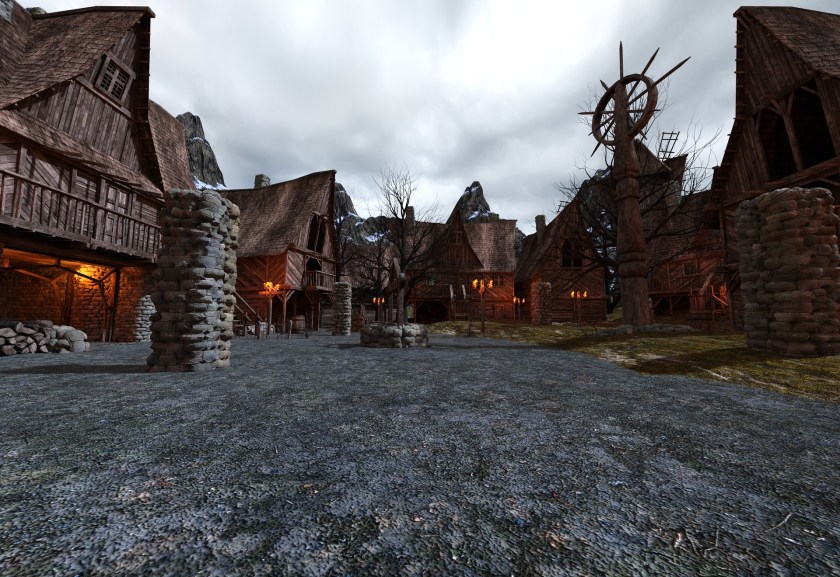
“Notice the broad walls there, and the wide allure way on top of the rampart. Those walls were newly fortified, just a year before the Xarmnians took the city. Do you know why?”
I shook my head, “I haven’t the slightest idea.”
He gestured upward, towards the cliff-side towering massively above the back way, its jagged stone faces catching the dim light forming almost an angry scowl down upon the city of Azragoth.
“What you said earlier. Scree. There is a fault line running up the side of the mountain ledge’s face. The area is broken, and parts of the massive rock have slid partway down the mountain. Eventually, that weight will break and crush the stone below it. Water pools behind the slabs with each rain, and it trapped there. Winters freeze it, and the forming ice further fissures the rock as the melting and freezing cycle drives water deeper into the jagged cracks in the rocks below. Azragoth was a prospering city, growing faster than was ever planned for when the land was first cleared. It was built, perhaps too close to the mountain edge and cliff-side. One evening the original wall was smashed open when a heavy rain loosed a great slab that slid and tumbled down the mountain, breaching the wall and killing the people that lived in the apartments just below it. They had believed they were in the safest place in the city, far from the main gates, and the postern gates. Yet they died in a sudden tragic moment because of…scree.”
I pondered that a moment. Such a terrible image of the wall crashing down through wooden beamed ceilings, burying those people in the rubble and rock. Azragoth had had more than its fair share of tragedy.
“Yet out of that tragedy, the back wall was rebuilt and fortified, thicker and taller than it had ever been before. You might say the backend of the city is far stronger than any other place within these walls. It is where Maeven and some of the other children hid with the cleric and his family so long ago. Ironically, sheltering in the very shadow of prior deaths. You didn’t know that, did you?”
I shook my head, “No I did not.”
“And as to detritus,” he continued after a reflective pause,” there is a custom here observed by every one of adult age who stays here in our fair city. It is one, which might cause the people you lead to protest having ever come here. It is not one we particularly enjoy, but it serves its purpose to remind us of what lead to the plague that killed most of our citizens as well as the occupiers. Maeven may already have told you of the time and dispensation we received from that tragedy. We are now into our twentieth season. A costly dispensation purchased in blood but began as a foolish oversight. Our city is served by a series of cisterns in the public square. These are fed by the rivers flowing from the highland, down through the forests and breaks and into the lower valley basin below. Our town, like any other town, faced the problem of removing waste from the village streets without spoiling the freshwater of the spring-fed wells we all drank from. Long ago a series of trenches were dug under the street pavements, and gutters were created to wash out refuse beneath the city. Every street in the city has a small canal of wastewater running beneath flat paver stones on the lower edge of the street. Mortared barrel tiles form their lining. We call these waterway trenches ‘gullets’.”
He braced himself against the balcony balustrade, looking down into the city streets below.
“Early designers of the city of Azragoth diverted veins from the river Trathorn forming a small branched canal that feeds water to the closed city for this very purpose. Over time, these gullets were taken for granted. Water made its way in, under the city walls, and ran down into the sewage gullets and its flow pushed wastewater underneath and out of the other side of the city and down the valley. The cesspits from the garderobes also flow down into the gullet canals so you can imagine the vile filth that builds up down there. Left to neglect, detritus had built up in the gullets over time, greatly restricting the amount of water that flowed through them. As the raw sewage built up in the gullets it attracted the woodland rats, which entered the city through these gullet canals. These rodents lived and bred by the thousands in the sewage, stealing out in the evenings to forage for whatever rubbish and refuse spilled from the market carts or collected in the rubbish bins behind homes and tavern halls which did not make it down into the sewers.”
Here he turned and looked at me.
“Detritus does not just wash up on a beach or riverbank, you know. It can be anything, from loose rock to limbs flowing down a river…or canals servicing the rubbish-drains beneath a city.”
He paused.
“This is where our custom comes in. It is a service we all perform in remembrance of those who passed. Something I was told to bring you and your people to, before meeting with the council. Every new thing is built with or upon something broken. Buildings rise, but before they can the ground must be broken to hold a foundation. Every stone wall is built of broken rock. Every sprouting seed is planted in and arises from broken ground. Every new working idea most often follows upon the heels of many failures. This is what it will take for your people to learn to be warriors in a dangerous land. As you say, mountains rise from the land by breaking through the topsoil, when all that is underneath them is in upheaval. It took a terrible disaster to teach us this. A master’s work starts with small broken pieces, and is brought together and refashioned into something more than can be imagined. This is the lesson of Azragoth.”
From the balcony, we were led down another series of steps to a central courtyard where most of the main streets radiated from around a circular central hub with a wide-open area and projecting galleries and shops lining the headings of each block. We assembled around Corimanth and Morgrath and the other soldiers, their swords sheathed for the moment, as townsfolk poured into the stone park from side streets and shops. This was the marketplace were the first incidents had happened. This was the starting place for it all. The vendor carts had all been covered and locked down and rolled off to the various homes and stall ways. Shopkeepers had brought all of their wares into the shop alcoves for the night. The area was open, and the sea of brightly colored tent canopies were all folded and put away for the evening. But for the people, the open-area market was stowed for the night and the crowd had dutifully assembled to perform the custom that Corimanth had spoken of. Children watched from the balconies and peripheries, familiar with what would happen shortly, but we were still unaware. A delegation of men and women, in clothes seeming more in line with collecting houses and lenders, came forward through a parted pathway, from a pavilioned terrace. Each carried before them a large pole with a half-mooned metal blade affixed to the end of each pole, that was mired in blackened filth and smelled awful. The citizens of Azragoth revealed small metal hooks from their sides, with a blunted and flattened tip. They moved along the side of each street at the low leeward end of the thoroughfare. From the radiating center of the courtyard, we could see citizens lining each of the radiating streets from the city center to beyond the view where each street curved away, following the natural contour of the ground upon which the city was built.
I leaned into Begglar, as he and Nell and Dominick were the only ones in our company, save Maeven, who might be aware of what was about to transpire. In a few more hours, the land would grow dark, and I was not sure of what was coming.
“What do you know about this custom?”
Begglar shook his head, “It has been many years since I have been to Azragoth. Much has changed. My trips were only day trips, so I have never had the occasion to be here at dusk. Nell does not visit here for obvious reasons. Dominick usually comes with me to help load the wagon, but we have not had the ability to come since the Xarmnians have occupied our highlands. Whatever trade had been done was meted out by the Xarmnians and we’ve always received the short-end of those deals. We had no idea Corimanth was even here. I’m sure she and he will have much more to say to each other in private.”

 Excavatia
Sounds like O’Brian has a great role-model in this story. And we’re almost to where we get to learn about Nell’s gift!
LikeLiked by 1 person
He will have several “teachers” along the way. Even a leader must be always open to learn.
LikeLike